
Music Therapy for Children’s Mental Health: Can Music Support Emotional Wellbeing?
Can music improve children’s emotional wellbeing? Explore the role of music therapy in supporting mental health, confidence and healthy emotional development.
MUSIC THERAPY
10/15/20265 min read


Some children announce their feelings at full volume. Others come home from school, drop their bag and disappear upstairs, and by teatime you’ve tried everything from gentle questions to a biscuit.
“I don’t know” is usually the answer, and it’s usually true. A seven-year-old can feel something enormous without having the first idea what to call it.
That gap between feeling and saying is where we spend much of our time at Chorus Music Therapy & Education in Cambridge.
Music therapy provides children an outlet to channel emotions in an unspoken manner. The therapists at our company are registered with the HCPC. Music therapy is about using singing, musical instruments, and body movement rather than musical lessons and musical performances. In addition, there are no requirements for any prior musical training to take part in music therapy. The basics of music therapy are addressed on the Music Therapy page on our website.
One honest note before we go on. The evidence for this work is still growing, and music therapy for children isn’t a cure for anything. It sits beside family, school, and your GP as one part of child mental health support.
Can Music Therapy Help Children With Anxiety?
It can help plenty of children, and the way it works is quieter than people expect.
Picture a child who plays fast and tight, stiff in the hands, glancing at the therapist every few seconds. The therapist doesn’t tell them to relax. They match that speed first, so the child feels met, then ease the tempo down a notch at a time.
Quite often the child follows without noticing, and their shoulders drop on the way.
Music therapy for anxiety also leans on a few simple things:
A hello song that stays the same every week, so there’s one thing the child can predict
Improvising, where nothing can be played wrongly
Small practice runs at waiting for a cue or letting someone else choose
Many anxious children are terrified of getting things wrong. In a session, a slip just becomes part of the tune, and some children visibly relax the first time they realise that. It won’t replace medical advice, though.
If worry is affecting your child’s sleep, eating or school attendance, speak to your GP as well, because music therapy for anxiety works best alongside other support.
Can Music Help Children Express Their Feelings?
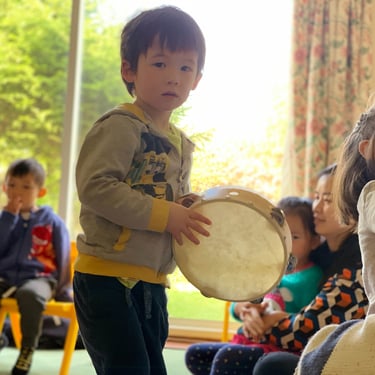
You will get a shrug from a six-year-old if you ask them what being angry is. However, give them a drum, and you will understand immediately. Loud, soft, fast, start and stop - music speaks. A xylophone played softly creates an emotion more clearly than a child explaining anger ever will.
The therapist answers in sound, and that matters. The child isn’t being questioned or corrected, just heard. If a child arrives after a bad day and hits the drum hard, we play with them, stay alongside and wait. Sometimes the words come later. Sometimes they don’t, and the drumming has already done its job.
Teenagers tend to go another way. They bring in a song that’s been on repeat all week, or write a few lines of their own. Talking about someone else’s lyrics is far easier than talking about yourself, which makes children’s music therapy a useful way in for young people who’ve stopped answering questions at home. It’s child mental health support that doesn’t depend on conversation.
How Does Music Therapy Support Emotional Regulation?
Regulation means getting through a big feeling and coming back down again. Most adults are still working on it, so it’s hardly surprising that children find it tough. Music helps because beat, speed, and volume are physical.
A child can feel a fast pulse in their arm, then slow it, and that gives an abstract idea something to hold on to. It’s a large part of what music therapy for children offers those who are easily overwhelmed. Below are some points that tell you about musical activities that your child will be exposed to in the therapy and where it will help them in life.
Drumming to a steady beat: The child practices matching and adjusting their energy, which helps them by teaching them how to calm down after excitement.
Start-and-stop games: Taught by listening and impulse control, helps them develop patience and a habit of following instructions.
Loud-to-quiet improvisation: The child is taught to notice changing intensities, which helps them develop anger management skills.
Singing together: Taught through breath control and connection, and helps develop the feeling of being settled and satisfied.
Taking turns on instruments: The child practices patience and sharing among peers, which helps them with friendships and classroom life.
None of it feels like practice to the child, who thinks they’re playing. The therapist, meanwhile, is watching for when the pace picks up, when it stops and what the child goes back to, and shapes the next few minutes around that. The results show up elsewhere, slowly: on the walk to school, or in an argument about whose go it is.
At What Age Can A Child Start Music Therapy?
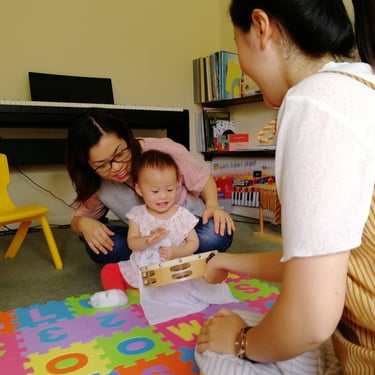
Earlier than most parents think. There’s no fixed minimum, so music therapy for children can begin in the toddler years, with a parent or carer in the room. From primary school onwards, it tends to be one-to-one or in a small group, and sessions at five look nothing like sessions at fifteen. Below is a list of types of activities your child will be exposed to based on their age group.
Babies and toddlers: Songs, rhythm and play with a parent or carer
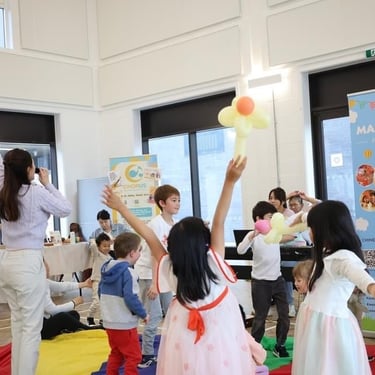
Preschool: Simple instruments, movements and singing together
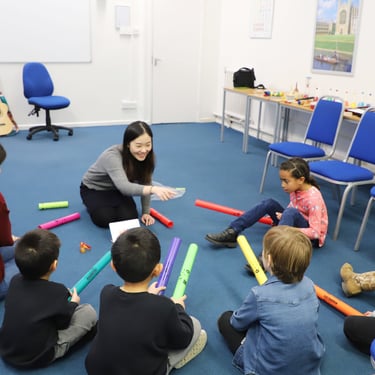
Primary school: Individual or group work with games and improvisation
Teenagers: Songwriting, listening, discussion and trying instruments
We also run group music therapy for children with special educational needs here in Cambridge, for families who’d like a group setting.
Music Therapy In Cambridge: Where To Start
For families looking for music therapy in Cambridge, we start with a chat. We’ll ask what your child enjoys, what’s been hard lately and what you’d like to see change. From there, the therapist suggests individual or group children’s music therapy sessions and talks through progress with you as things go.
If music therapy for children sounds like it might suit your family, get in touch with Chorus Music Therapy & Education . A short message is plenty to begin.
Frequently Asked Questions
1. Can music therapy help children with anxiety?
It can help some children feel calmer and cope better with uncertainty. It works best alongside other support.
2. Can music help children express their feelings?
Yes, instruments and songs let children show feelings they can’t yet put into words.
3. At what age can a child start music therapy?
There’s no minimum age. Babies and toddlers can join in with a parent or carer.
4. How does music therapy support emotional regulation?
Beat, speed and volume give children a physical way to practise calming down and waiting.
5. Does my child need any musical experience?
No, sessions follow your child’s lead, and no musical skill is needed.
Copyright © 2026 Chorus Music Therapy & Education - All Rights Reserved.
Chorus Music Therapy & Education Ltd (Company No. 15217688) · VAT Registered: (VAT No. GB 518654961) · Chorus Music Therapy CIC (Company No. 16755615)
Address
45 Queen Edith's Way,
Cambridge,
United Kingdom
CB1 8PJ
Contacts
Tel no: +44 7751 844300 (Cloris)/
+44 7356 044778 (Admin- Winnie)
Email address: info@chorusmusictherapy.co.uk