
Individual Music Therapy: It Starts With the Person, Not the Music
Discover personalised individual music therapy in Cambridge for children, young people, adults and older people. Learn how one-to-one sessions support communication, confidence and emotional wellbeing.
INDIVIDUAL MUSIC THERAPY
6/30/20264 min read
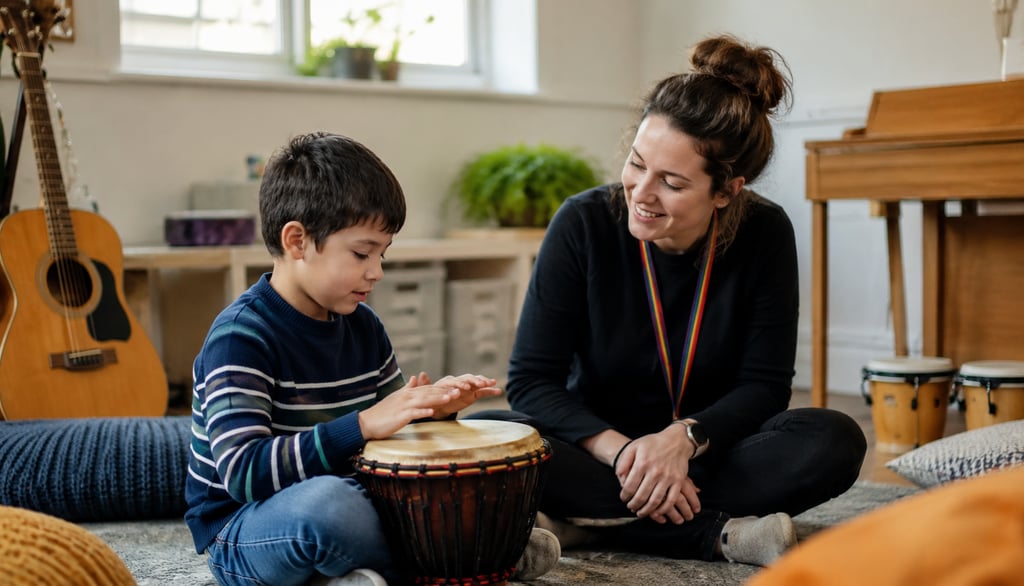
When families first get in touch with us, the conversation often starts in the same way.
Parents tell us they're worried their child won't join in. A husband wonders if his wife will feel comfortable. Someone caring for an older parent says, "They're probably not going to play an instrument."
We completely understand those concerns. Nobody needs to sing in tune, read music or know how to play an instrument. The session begins with the person sitting in front of us. Everything else comes later.
At Chorus Music Therapy, we've worked with children, teenagers, adults and older people, and one thing never changes. No two sessions are the same.
Some people are curious straight away. They walk over to the instruments before we've even had a chance to introduce ourselves.
Who Usually Comes For Individual Music Therapy?
There isn't one type of person. One morning, we might be working with a young child who finds communication difficult. Later that afternoon, we could be supporting an adult recovering after a stroke.
A few days might involve visiting someone living with dementia. Their situations are completely different, but they're all looking for the same thing, really.
A place where they don't feel judged.
A place where they don't have to find the right words.
A place where someone meets them where they are.
That's what we try to create.
What Actually Happens In A Session?
Probably less than people expect. There isn't a lesson plan pinned to the wall. Nobody is asked to perform or marked on how well they sing.
Sometimes a child spends ten minutes exploring different instruments because they're interested in the sounds.
Sometimes we sing together, sometimes we don't. Some sessions are lively, and others are much quieter.
If someone needs a bit more time to settle in, that's perfectly okay. We don't rush the process. We've learnt over the years that trust grows at different speeds. Trying to hurry rarely helps anyone.
Why Do People Choose One-To-One Music Therapy?
Because life isn’t the same for everyone, you know. Group sessions can be quite wonderful, but honestly, they’re not always the nicest spot to start from right away.
Picture stepping into a room full of people, while you’re already feeling anxious, or you’re having trouble getting your thoughts out for some folks, that can be simply too much. One-to-one sessions remove that pressure, a bit more gently.
There's space to pause, space to think. Some space to communicate in whatever way feels natural. We’ve even had parents say afterwards that it was the first thing their child actually looked forward to all week, somehow.
Not because anybody asked them to behave differently, or anything like that, but because they were accepted exactly as they were.
Do You Have To Enjoy Music Before You Start?
Not at all. Some people already love music. Others haven't really thought much about it. Both are welcome. Music is simply the way we build a connection.
For one person, that might be through singing.
For someone else, it could be tapping a steady beat, listening to familiar songs or experimenting with different sounds.
There's no right way to take part. That's one of the reasons individual music therapy works for so many different people. It gives people the freedom to respond in their own way rather than expecting everyone to follow the same path.
How Do You Know If Individual Music Therapy Is Helping?
This is probably one of the very first questions families ask us, and honestly, we get it. The truthful answer is that progress doesn’t always look like people expect, not even close.
It isn’t usually one big moment, like some clean before and after. More often, it’s a bunch of small ones, little by little kind of thing. Like a child who wouldn’t go near an instrument during the first session, might later reach out and pick one up a few weeks down the road.
Someone who always waits for the therapist to begin might suddenly start making music first. A teenager who found it difficult to stay in the room could stay a little longer than they did the week before. None of those things makes headlines.
But if you've been waiting months to see even the smallest step forward, they matter. Families often notice changes outside the sessions, too.
Sometimes a child seems more settled at home. Sometimes a teacher tells parents that a pupil has been joining in more at school. Every person's journey is different, so we never compare one client with another. We simply look at how far that individual has come.
Why Do Families Choose Chorus Music Therapy?
Every family's story is different. Some come to us after hearing about music therapy from a teacher or another parent. Others have spent months looking for the right kind of support.
Whatever brings someone to us, we know it can feel like a big step.
That's why we take time to listen before anything else. We want to understand the person, not just the reason they've been referred.
What do they enjoy?
What makes them feel comfortable?
What would they like help with?
Those conversations help us plan sessions that feel personal instead of following the same routine every week. At Chorus Music Therapy, we believe that building trust comes before anything else. Once that trust is there, everything else has room to grow.
Frequently Asked Questions
What is individual music therapy?
Individual music therapy is basically a one-to-one session with a qualified music therapist. In it, music is used to help with communication and emotional well-being, confidence and personal growth, but always in a way that fits the person.
Do I need any musical experience?
No, you don’t have to sing or play an instrument, and you don’t need to read music either. Sessions are built around you, not your musical ability.
Who can benefit from individual music therapy?
Children, young people, adults and older people can all benefit. Music therapy can support people with communication difficulties, learning disabilities, neurological conditions, dementia, autism and a range of emotional wellbeing needs.
Copyright © 2026 Chorus Music Therapy & Education - All Rights Reserved.




Address
45 Queen Edith's Way,
Cambridge,
United Kingdom
CB1 8PJ
Contacts
Tel no: +44 7751 844300 (Cloris)/
+44 7356 044778 (Admin- Winnie)
Email address: info@chorusmusictherapy.co.uk